Mark Batchelor and I flew from Heathrow to Berlin’s Brandenburg Airport on Thursday morning (30th April) and upon arrival caught the train to Berlin Hauptbahnhof, which was conveniently very close to our base for the next four days – the Hotel Amano Grand Central.
After checking in, we walked south through the station, across a pedestrian bridge over the Spree River and within sight of the Reichstag Building, into the large expanse of Tiergarten Park. Our aim was to reach Potsdamer Platz and in doing so, we passed the current home of the Berlin Philharmonie.
We then enjoyed a drink in a local bar before retracing our steps and returning to our hotel and a meal in its restaurant.
1st May
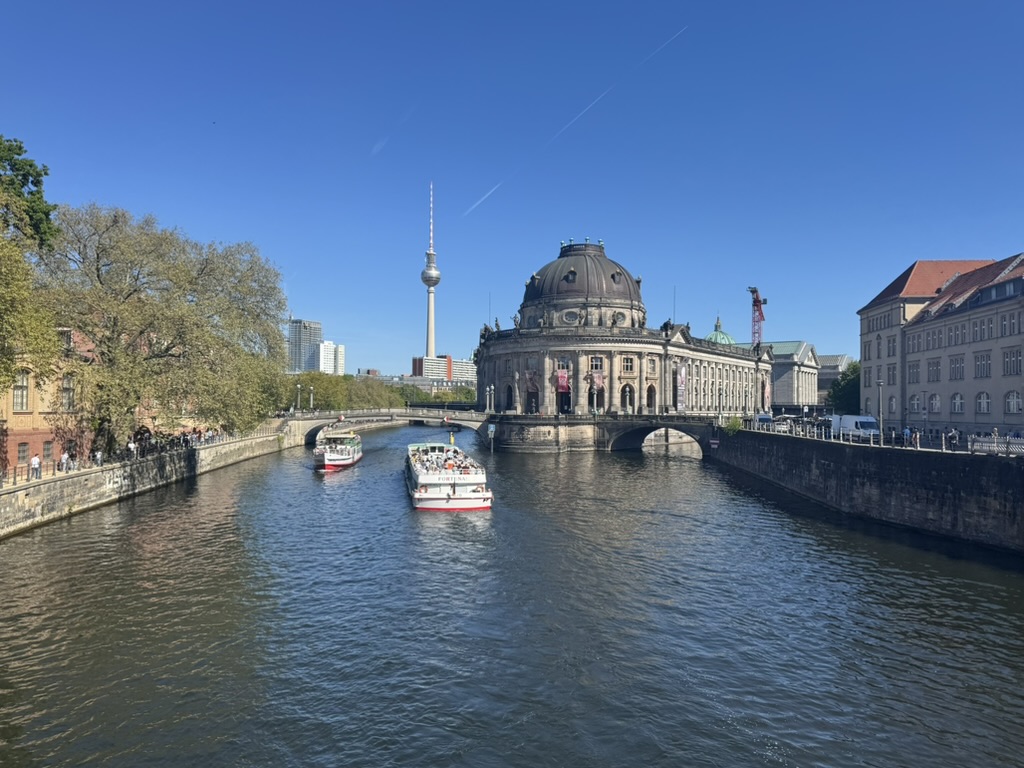
The following morning we booked a Spree River cruise and appreciated the numerous architectural wonders along the riverbanks during the hour-long journey, including the impressive Museum Island.
We then walked along the northside of the Spree, on the edge of the bustling Spandauer Vorstadt, and found an ideal café/bar in the railway arches overlooking James Simon Park.
In the afternoon, we visited Checkpoint Charlie in Kreuzberg and noted the former location of the Wall. The nearby Die Mauer, Das Museum, permits visitors to experience everyday life in the shadow of the Berlin Wall in a unique panorama exhibition by the artist Yadegar Asisi. In the especially erected rotunda in Berlin-Mitte, in the immediate surroundings of the former Death Strip and the border crossing, the monumental panorama shows on a backdrop of nine hundred square metres the West Berlin district of Kreuzberg in the 1980s. With accompanying sound effects and lighting, it made a hugely moving impact.

We then came across by chance a contemporary Volkswagon exhibition on Friedrichstraße, namely ICONIC – A Timeless Journey of Culture, Society and Mobility at The DRIVE, Volkswagen Group Forum. An interesting collection of design classics.
More progress brought us to the Brandenburg Gate and the opportunity for some tourist photography. Plus we could also see – in the distance – the Victory Column along the monumental straight highway that runs through the centre of the city. Finally, we strolled through the Friedrich Ebert Platz and noted the administrative and council buildings in the area.
After freshening up back at the hotel, we made our way to Casalot, a marvellous Middle Eastern restaurant on Heidestraße. Highly recommended.
2nd May
Saturday saw us catch a train out to Charlottenburg and the Schlossgarten palace and gardens. This is the largest and most magnificent palace in Berlin – a highlight for any Berlin visitor.
We learnt of Sophie Charlotte, the first Queen consort in Prussia, who was not only an accomplished musician on the harpsichord and known for singing Italian opera, but who also strolled through the grounds here with her friend, the renowned scholar and philosopher Gottfried Wilhelm Leibniz. When Sophie Charlotte died, just 36 years old, the palace and the area around was named Charlottenburg after her.

We lunched at Samowar, a local restaurant/bar sited next to the river and I should add that we were blessed with glorious sunshine throughout our trip, which allowed us to drink and dine outside on several occasions.
I had noted in advance the opportunities for live music and that evening, we travelled west to the The Hat Bar in Zoologischer Garten, which since 2015 has continued the tradition of its older brother and namesake in St Petersburg in offering an impressive menu of cocktails and live music. Every day of the week, at 9pm, a jam session kicks off with a fluid line-up of the best club jazz musicians from around the globe. A great night out.

3rd May
First up on Sunday was an ascent in the landmark TV Tower, which gave us a fabulous 360 degree view over the city. Back at ground level, we then took the opportunity to take in the striking Nikolaikirchplatz (St Nicholas Church) and surrounding historic houses.
Our next stop was Hansa Studios on Köthener Strasse, which is a recording facility located in the Kreuzberg district. The studio, initially famous for its Meistersaal recording hall, is situated close to a section of the former Berlin Wall, giving rise to its former nickname ‘Hansa by the Wall.’ It became particularly famous for being where David Bowie recorded Heroes in 1977. Other notable artists who have recorded here include Iggy Pop, U2, the Nina Hagen Band, Tangerine Dream, Depeche Mode, Killing Joke, David Sylvian, Nick Cave and The Bad Seeds, Einstürzende Neubauten, Marillion, Siouxsie and the Banshees, Wire, The Psychedelic Furs, the Pixies, Manic Street Preachers, Snow Patrol and recently, Biffy Clyro.

A short walk from the Studio there is a memorial to the Berlin Philharmoniker, which operated as the Reichsorchester under the Nazi regime. Its primary concert hall was destroyed on January 30, 1944, when Allied bombers levelled the orchestra’s legendary home on Bernburger Straße during a late afternoon air raid. Despite severe wartime disruptions and travel hazards, the orchestra continued to perform and record.
Moving to the north, we came across the site of the Fuhrerbunker, the centre of the Nazi regime in 1945, and where Hitler and Eva Braun were married in April of that year and where they ended their lives shortly afterwards. The spot is simply marked by a single board, principally to prevent the location becoming a place of pilgrimage for modern-day Nazis.
Close by is the Memorial to the Murdered Jews, a place of contemplation, remembrance and warning. In 1999, the German parliament agreed to establish this central memorial site, designed by New York architect Peter Eisenman, and it was ceremonially opened in 2005.
On a site covering 19,000 square metres, Eisenman placed 2,710 dark concrete stelae of different heights. The area is open day and night and from all four sides you can be immersed in the accessible spatial structure. The memorial is on a slight incline and its wave-like form is different wherever you stand. Its openness and abstractness give you space to confront the subject matter in your own personal way.
4th May
Our final day in Berlin and keen to complete our Bowie-related explorations, we took the underground train to the Schöneberg district where – from 1976 – Bowie and Iggy Pop lived in a seven-room flat at Hauptstraße 155. Bowie evidently spent his time painting and soaking up the underground electronic and avant-garde art scenes. He was a frequent patron of the nearby 24 hour café Neues Ufer (then called ‘Anderes Ufer’). Unfortunately this was shut when we visited.

To the north we discovered Heinrich von Kleist Park, a particularly interesting site historically. The park is named after Heinrich von Kleist (1777–1811), one of Germany’s most influential dramatists and prose writers, so the name itself reflects Berlin’s tradition of commemorating key cultural figures in its public spaces. It was originally created in the XVIII century as a botanical garden, with palm trees in greenhouses and other exotic plants.
At the beginning of the 20th century, a part of the area was turned into a racing track, where in 1909 the ‘Rennbahnkatastrophe von Berlin’ sadly occurred, when a motorbike rider lost control of his machine and drove into the crowd, killing nine people and injuring forty. After the accident the area was completely converted to a park.
A court building, a large neo baroque structure, remains located in the middle of the park. It has served as a seat for a court since 1913, after the area was converted from the botanical garden into its current style. The building has seen some moments in history. For example, in 1944, the remaining conspirators involved in the ‘July 20’ plot to kill Hitler were sentenced to death at the court. Whilst in 1945 the first meeting of the Nurnberg Court took place here, plus in 1948 the allied forces held a meeting in the building to decide the division of Germany among the four allied powers.
Also worth mentioning, lining the entrance to the Park, stands The Königskolonnaden, which are two colonnades built in the 1770s according to plans by Carl von Gontard. They originally stood on Königsstraße in Old Berlin and were moved to Heinrich von Kleist Park in 1910.

There is no doubt that so much of Berlin contains and reflects elements of its past. You never seem very far from references to the Wall and are regularly reminded of the city’s place in history.
On a sporting note, we still had time before the flight home to take in the Olympiastadion (aka the Berlin Olympic Stadium), which was originally designed by Werner March for the 1936 Summer Olympics. Since renovations in 2004, the site has a permanent capacity of 74,475 seats and is the largest stadium in Germany for international football matches. Besides its use as an athletics stadium, the arena has a significant tradition. Since 1963, it has been the home of the Hertha BSC. In addition, it hosted three matches in the 1974 FIFA World Cup and was renovated for the 2006 FIFA World Cup, when it hosted six matches, including the final. The venue also served as a host for the 2011 FIFA Women’s World Cup as well as the 2015 UEFA Champions League final.

A train ride back into the city centre followed and, having checked out of our hotel, we caught the train from Berlin Hbf to the airport. An informative and invigorating trip.